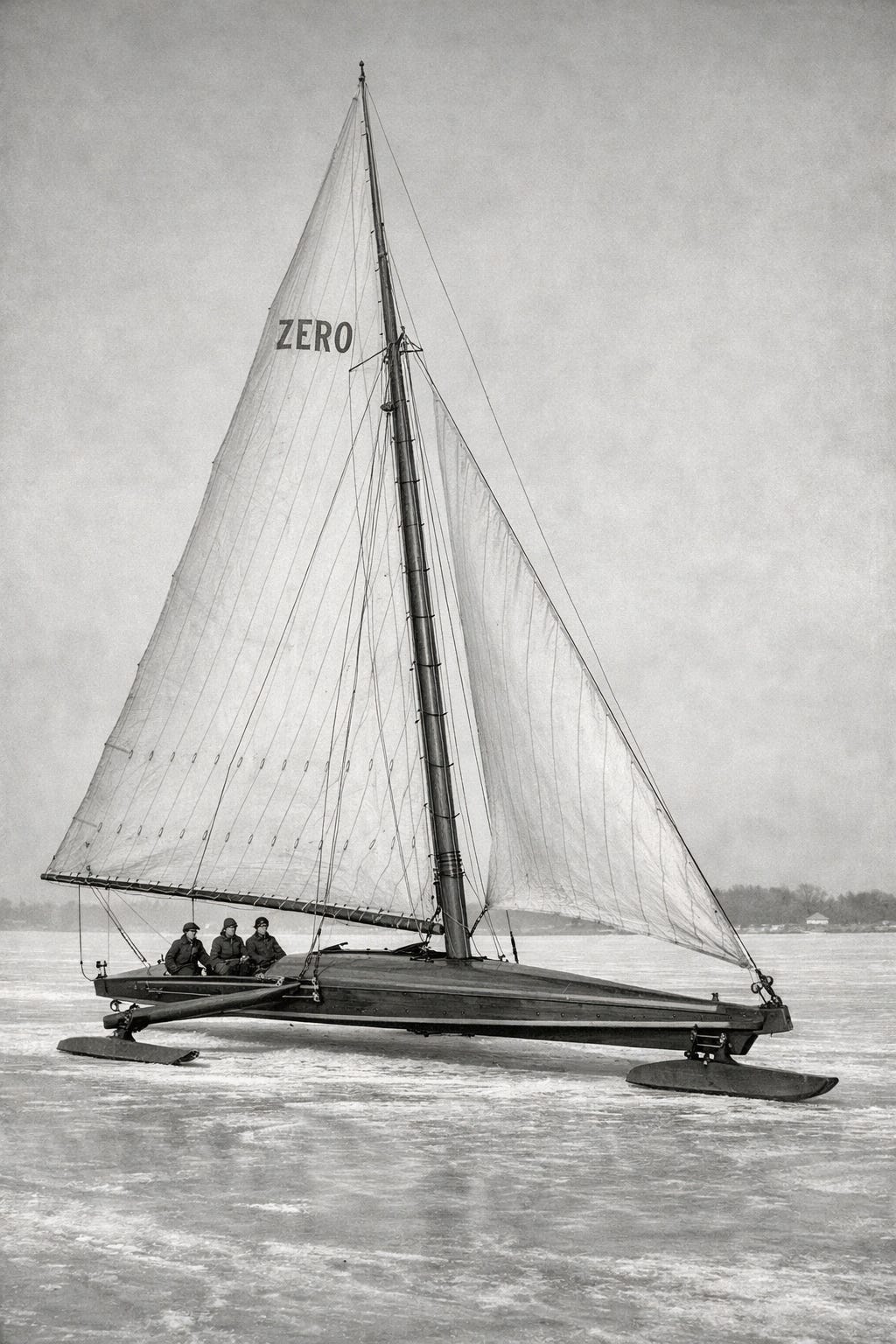
Ward Burton’s Iceboat Zero
The fastest craft ever documented on Lake Minnetonka.

In the early twentieth century, long before jet engines or high-performance automobiles redefined the limits of speed, one of the fastest vehicles in America traveled not on roads or rails, but across ice. On the frozen surface of Lake Minnetonka, industrialist and speed enthusiast Ward Burton built an extraordinary machine: a giant iceboat known as Zero. Designed with a singular purpose — to go faster than anything that had come before — Zero became one of the most remarkable wind-powered craft of its era and a lasting legend in Minnesota’s technological and cultural history.
Iceboating had already become a popular winter sport in the Upper Midwest by the late 1800s, but most iceboats were small, recreational craft. Burton envisioned something far more ambitious. Backed by wealth, engineering curiosity, and a passion for velocity, he commissioned the construction of an ice yacht of unprecedented scale. Zero was closer in spirit to a racing yacht or experimental aircraft than to a hobbyist’s sled. Its long, narrow wooden fuselage, mounted on three steel runners, minimized friction while maximizing stability at extreme speeds. Unlike most iceboats of the time, it featured stern steering, allowing finer control when traveling at velocities that bordered on the unimaginable for the period.
Iceboating had already become a popular winter sport in the Upper Midwest by the late 1800s, but most iceboats were small, recreational craft. Burton envisioned something far more ambitious. Backed by wealth, engineering curiosity, and a passion for velocity, he commissioned the construction of an ice yacht of unprecedented scale. Zero was closer in spirit to a racing yacht or experimental aircraft than to a hobbyist’s sled. Its long, narrow wooden fuselage, mounted on three steel runners, minimized friction while maximizing stability at extreme speeds. Unlike most iceboats of the time, it featured stern steering, allowing finer control when traveling at velocities that bordered on the unimaginable for the period.
Zero’s most famous achievement took place on Lake Minnetonka, where it reportedly traveled from Gideon Bay to Wayzata — approximately five miles — in about three minutes and forty-five seconds. This performance equates to an estimated speed of around 80 miles per hour, an astonishing figure at a time when most automobiles struggled to exceed 30 mph. If accurate, this run makes Zero the fastest craft ever documented on Lake Minnetonka, surpassing all motorboats known to have operated on the lake.
Beyond raw speed, Zero represented a broader moment in American innovation. The early 1900s were an era of experimentation — in aviation, automotive engineering, and hydrodynamics — and Burton’s iceboats fit squarely within this spirit. In many ways, Zero functioned as a laboratory on ice, exploring aerodynamic efficiency, structural strength, and the conversion of wind energy into unprecedented forward motion. Burton later built another legendary craft, Northern Light, which was reportedly clocked at speeds approaching 118 miles per hour, placing it among the fastest wind-powered vehicles in recorded history.
Zero stands as a symbol of human ambition, engineering ingenuity, and the unique role Lake Minnetonka played in American leisure and technological progress. It also represents a direct ancestor of modern competitive iceboats, whose sleek forms and high-speed capabilities echo the principles Burton pioneered over a century ago.
In the story of speed, Zero occupies a rare and compelling chapter — a machine that harnessed winter, wind, and imagination to push beyond the limits of its time. On the frozen expanse of Lake Minnetonka, Ward Burton’s iceboat did more than race; it redefined what was possible.